
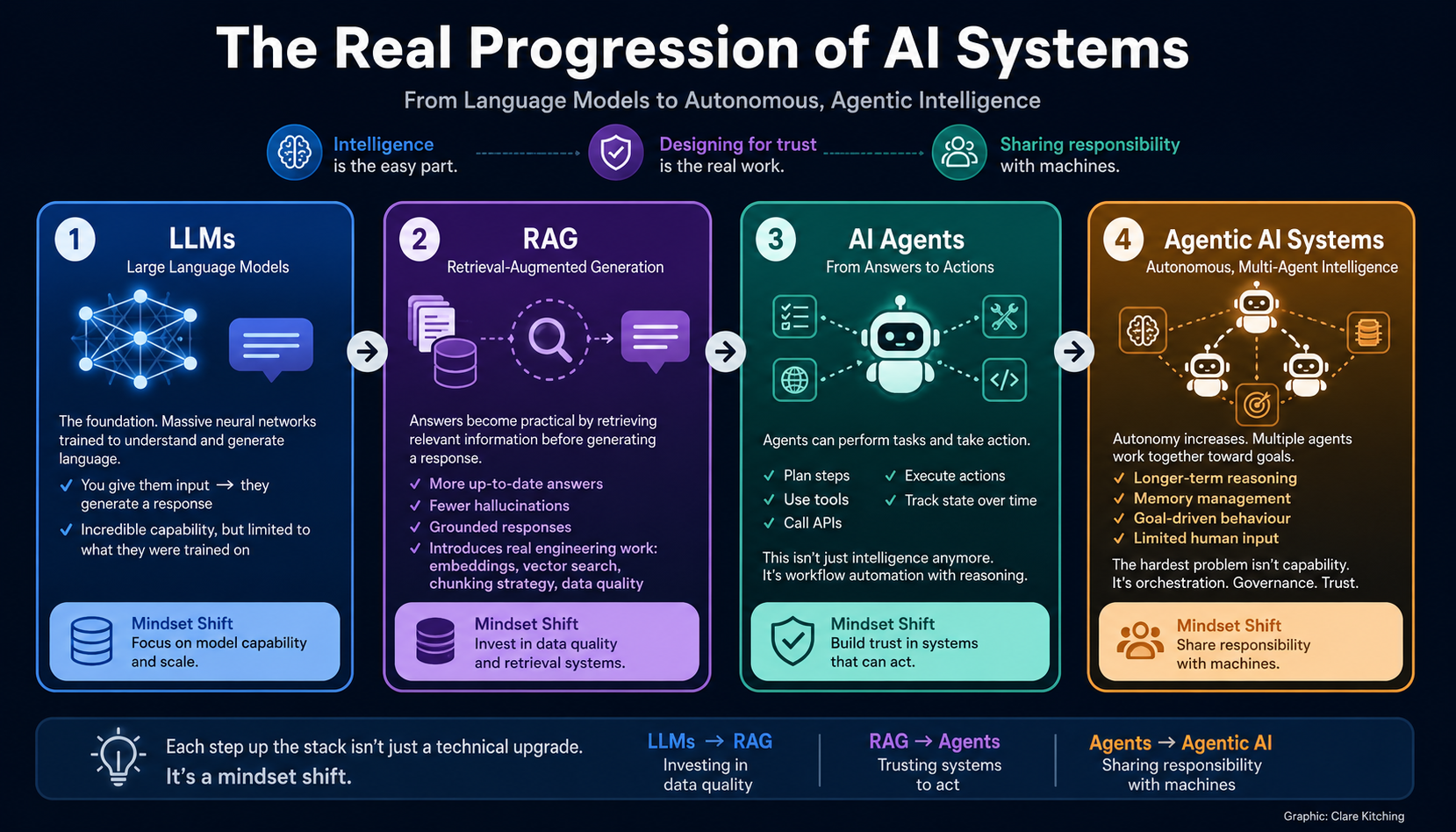
The Evolution of AI: From LLMs to Agentic AI Systems
Artificial Intelligence is evolving much faster than most people realize. While many believe modern AI is simply a chatbot powered by a Large Language Model (LLM), today’s intelligent systems are far more sophisticated. Behind the scenes, real-world AI applications combine language models with retrieval systems, memory, external tools, APIs, and autonomous decision-making capabilities.
Understanding this evolution helps organizations build smarter, more reliable, and trustworthy AI solutions. Let’s explore the four major stages of modern AI.
1. Large Language Models (LLMs)
Large Language Models (LLMs) are the foundation of modern generative AI. These models are trained on vast amounts of text data to understand language patterns and generate human-like responses.
An LLM can:
- Answer questions
- Generate content
- Translate languages
- Summarize documents
- Write code
However, LLMs have an important limitation—they rely primarily on the knowledge learned during training. They do not automatically know recent events or proprietary business information unless that knowledge is provided.
Benefits
- Natural language understanding
- Excellent content generation
- Strong reasoning abilities
- Fast response generation
Limitations
- Knowledge may become outdated
- Can produce hallucinated answers
- No access to private organizational data by default
Mindset Shift: Focus on building capable language intelligence.
2. Retrieval-Augmented Generation (RAG)
Retrieval-Augmented Generation (RAG) extends the capabilities of LLMs by connecting them to external knowledge sources before generating responses.
Instead of relying solely on trained knowledge, a RAG system:
- Searches relevant documents
- Retrieves the best information
- Sends that information to the LLM
- Generates an accurate, context-aware response
This approach significantly improves factual accuracy and keeps AI responses grounded in trusted information.
Core Components
- Embedding Models
- Vector Databases
- Document Chunking
- Semantic Search
- Prompt Engineering
Benefits
- Up-to-date information
- Reduced hallucinations
- Better enterprise knowledge access
- More reliable responses
Engineering Challenges
- Data quality
- Chunking strategy
- Embedding optimization
- Vector search performance
- Retrieval accuracy
Mindset Shift: Invest in data quality instead of relying only on model size.
3. AI Agents
The next evolution moves beyond answering questions. AI Agents can perform tasks independently by reasoning through problems and interacting with external systems.
Unlike traditional chatbots, AI agents can:
- Plan tasks
- Make decisions
- Use APIs
- Execute tools
- Read databases
- Generate reports
- Send emails
- Automate workflows
Agents continuously evaluate their progress and decide the next best action until the objective is achieved.
Typical Workflow
User Request → Planning → Tool Selection → Action Execution → Observation → Final Result
Key Capabilities
- Multi-step reasoning
- Workflow automation
- API integration
- State management
- Tool orchestration
Mindset Shift: Build systems that can act—not just respond.
4. Agentic AI Systems
Agentic AI represents the next generation of intelligent systems where multiple AI agents collaborate toward achieving complex business goals with minimal human intervention.
These systems include:
- Multiple specialized agents
- Shared memory
- Long-term planning
- Goal-oriented execution
- Dynamic decision-making
- Autonomous collaboration
Instead of one AI handling every task, different agents specialize in planning, coding, retrieval, monitoring, validation, and execution.