
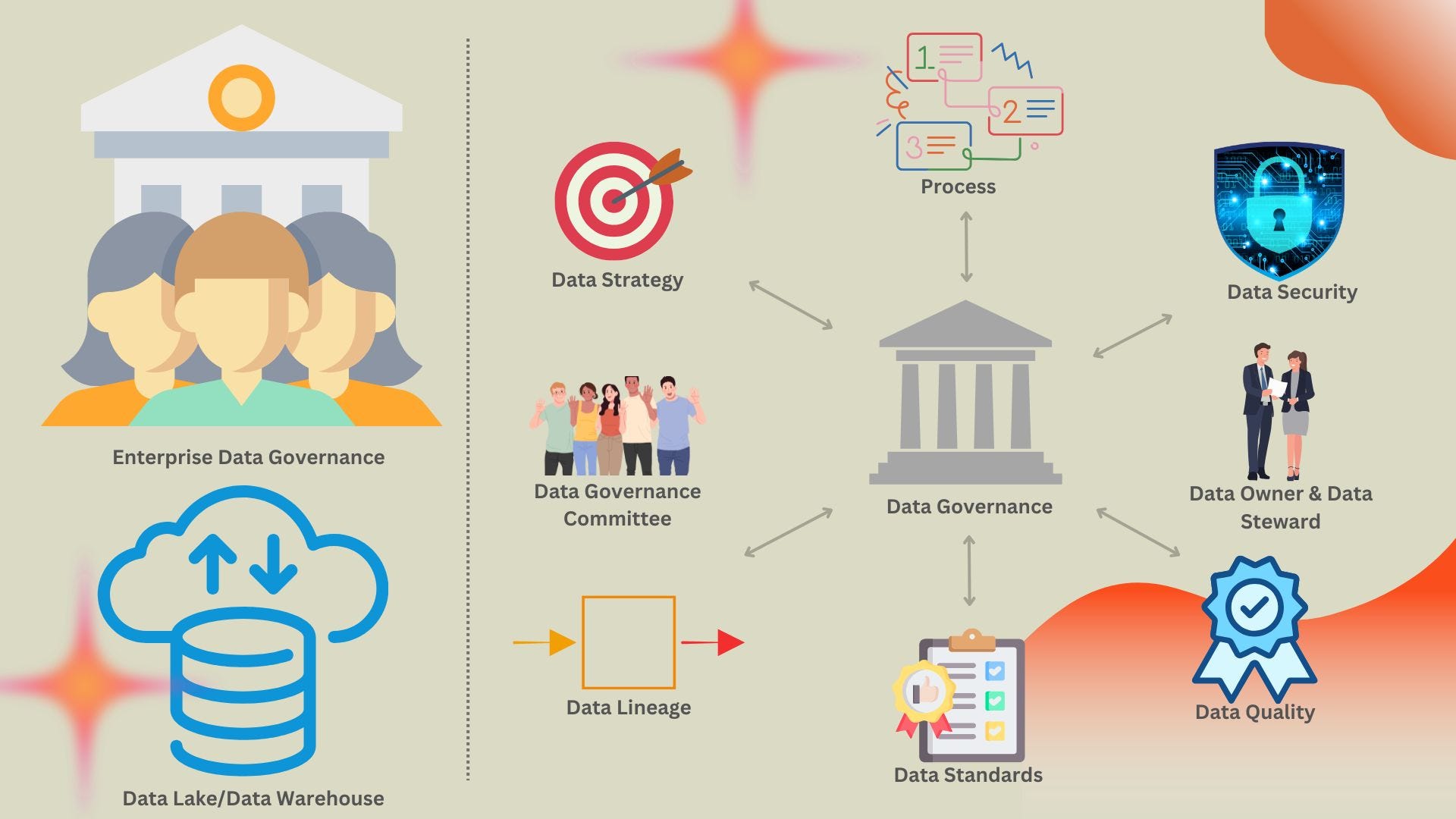
Enterprise Data Governance: Best Practices for Secure, High-Quality Data
Introduction
Data has become one of the most important assets for modern enterprises. Organizations use data to understand customers, improve operations, support business decisions, and develop artificial intelligence solutions.
However, managing data across cloud platforms, business applications, databases, and analytics systems creates significant challenges. Inconsistent records, unclear ownership, unauthorized access, and poor data quality can undermine business decisions and increase operational risk.
Enterprise data governance provides a structured approach to managing data throughout its lifecycle. It defines who owns data, how it should be protected, what quality standards it must meet, and how it can be used responsibly.
In this guide, we explore the fundamentals of data governance, essential implementation practices, and practical ways enterprises can build a secure and reliable data environment.
What Is Enterprise Data Governance?
Enterprise data governance is the combination of policies, responsibilities, standards, and controls used to manage organizational data.
It establishes how data is collected, classified, stored, accessed, shared, maintained, and retired.
A governance framework typically brings together business leaders, data owners, IT teams, security specialists, and compliance professionals.
Key areas include:
- Data ownership and accountability.
- Data quality and consistency.
- Data classification and protection.
- Access management and privacy.
- Data lineage and documentation.
- Retention and lifecycle management.
- Regulatory and policy compliance.
Data governance is not simply a technical implementation. It requires cooperation between the people who understand business information and the teams responsible for managing the systems that store and process it.
Why Data Governance Matters for Enterprises
1. Improve data quality
Business applications often store information across multiple systems. Without common standards, the same customer, product, or transaction may be represented differently across departments.
Data governance establishes validation rules, definitions, and quality checks that help identify incomplete, inaccurate, duplicated, or inconsistent records.
2. Strengthen data security
Organizations need to know which data is sensitive, who can access it, and how it is protected.
Classification and access policies help prevent confidential information from being exposed to unauthorized users or applications.
3. Support regulatory compliance
Organizations may have legal, contractual, and industry-specific obligations concerning personal information, financial records, and other sensitive data.
A governance framework helps document applicable requirements, assign responsibilities, and maintain evidence of relevant controls.
4. Enable reliable analytics
Analytics and reporting systems depend on trustworthy data.
Consistent definitions, documented sources, and quality controls help teams interpret business metrics correctly and reduce conflicting reports.
5. Prepare data for artificial intelligence
AI applications depend on appropriate data sources, reliable information, and controlled access.
Data governance helps organizations identify approved datasets, understand data lineage, manage sensitive information, and establish clear rules for AI training and retrieval systems.
Seven Enterprise Data Governance Best Practices
1. Establish clear data ownership
Every important dataset should have a clearly identified owner or accountable business function.
Data owners help define how information should be used, which quality standards apply, and who should be allowed to access it.
Data stewards can support these responsibilities by maintaining definitions, reviewing quality issues, and coordinating improvements.
For example, a customer data owner may define the authoritative customer identifier and establish rules for resolving duplicate records across business applications.
Clear ownership prevents data governance from becoming an activity that everyone expects another team to manage.
2. Create a data classification framework
Not all organizational data requires the same level of protection.
Define classification categories that reflect business sensitivity and applicable requirements. A simple framework might distinguish public, internal, confidential, and highly restricted information.
For each category, specify appropriate requirements for:
- Access permissions.
- Encryption and storage.
- Sharing and transfer.
- Retention and deletion.
- Logging and monitoring.
- Use in analytics and AI applications.
Apply classification consistently across databases, file repositories, cloud storage, and relevant business systems.
Classification should guide practical controls rather than exist only as a label in documentation.
3. Implement data quality controls
Reliable business decisions require data that is sufficiently accurate, complete, consistent, and timely for its intended purpose.
Define measurable quality rules for critical datasets.
Examples include validating required fields, checking date formats, identifying duplicate records, and verifying that related records satisfy business constraints.
Automated data quality checks can run during ingestion, transformation, and reporting workflows.
When a quality issue is detected, assign ownership and track the problem through resolution. Monitoring without a process for correcting issues provides limited long-term value.
4. Maintain a data catalog and lineage
A data catalog helps users discover available datasets and understand their meaning, ownership, and intended use.
Data lineage describes how information moves from its original source through transformations and into downstream systems.
Together, these capabilities help organizations answer questions such as:
- Where did this report’s data originate?
- Which applications depend on this dataset?
- What transformations were applied?
- Who is responsible for maintaining the information?
- Which systems may be affected if the source changes?
Accurate lineage can also help teams investigate data quality problems and assess the impact of system migrations.
5. Enforce least-privilege data access
Employees, applications, and automated processes should receive only the data permissions required for their responsibilities.
Use role-based or attribute-based access controls where appropriate. Review permissions regularly and remove access that is no longer needed.
For cloud data platforms, consider separate roles for data administrators, analysts, application services, and automated pipelines.
Sensitive datasets may require additional approval, auditing, masking, or restrictions on exporting information.
Access should be checked by the systems that serve the data rather than relying only on frontend controls or assumptions about user identity.
6. Define retention and lifecycle policies
Keeping all data indefinitely can increase storage costs, privacy risks, and the complexity of managing information.
Define retention periods according to business needs, legal obligations, contractual requirements, and relevant data protection rules.
Establish procedures for archiving, deletion, and handling backup copies.
Where data must be preserved for legal or regulatory reasons, ensure that retention controls respect applicable obligations and legal holds.
Lifecycle policies should be implemented consistently across databases, cloud object storage, analytics platforms, and other repositories.
7. Integrate governance into AI and analytics
AI systems and analytics platforms often combine information from multiple sources. Without suitable governance, they may use outdated, inaccurate, unauthorized, or sensitive information.
Before approving a dataset for AI use, assess its source, quality, permissions, sensitivity, and intended purpose.
For retrieval-augmented generation (RAG) applications, enforce user permissions during document retrieval. A model should not expose confidential documents merely because those documents are present in its knowledge source.
For AI training or fine-tuning, assess whether the data is suitable for the intended use and whether relevant privacy, licensing, and contractual requirements have been addressed.
Monitor the quality and appropriateness of data as systems and business requirements evolve.
Building a Data Governance Architecture
An effective enterprise data governance architecture combines organizational policies with technical controls.
Governance and ownership layer
Defines data owners, stewardship responsibilities, policies, approval processes, and escalation procedures.
Metadata and discovery layer
Maintains data catalogs, business definitions, classifications, and lineage information.
Data quality layer
Validates records, detects inconsistencies, measures quality, and tracks remediation.
Security and privacy layer
Enforces access controls, encryption, monitoring, retention requirements, and appropriate data-sharing restrictions.
Data platform layer
Includes databases, data warehouses, data lakes, integration pipelines, and analytics systems where governance controls are applied.
Monitoring and reporting layer
Tracks policy exceptions, quality metrics, access activity, and governance progress.
These layers should work together. For example, a catalog may identify a dataset as confidential, while the platform enforces restricted access and the monitoring system records relevant access events.
Implementing Data Governance Across Cloud Platforms
Enterprises may store information across AWS, Microsoft Azure, Google Cloud, and third-party applications.
The objective is to establish consistent governance principles while accounting for each platform’s capabilities.
AWS
Evaluate suitable data cataloging, access management, encryption, audit logging, and data protection capabilities for the organization’s AWS workloads.
Microsoft Azure
Use appropriate data management, identity, cataloging, and monitoring capabilities to support governance across Azure resources and connected data platforms.
Google Cloud
Evaluate data discovery, access management, metadata, quality, and monitoring capabilities for workloads hosted on Google Cloud.
Multi-cloud governance
Maintain common definitions for data ownership, classification, access review, and quality standards across environments.
Avoid assuming that a single catalog or policy automatically governs every system. Verify integrations, permission synchronization, lineage coverage, and enforcement behavior.
A Practical Data Governance Implementation Roadmap
Step 1: Inventory critical data. Identify important datasets, where they are stored, which applications use them, and who owns them.
Step 2: Assess current risks. Review data quality, sensitive information exposure, unclear permissions, retention practices, and missing documentation.
Step 3: Define policies and responsibilities. Establish classification standards, data ownership, access approval, and quality requirements.
Step 4: Implement technical controls. Introduce suitable cataloging, access management, quality validation, monitoring, and lifecycle policies.
Step 5: Start with a pilot dataset. Choose an important dataset, apply the framework, and measure whether the controls improve visibility and quality.
Step 6: Expand incrementally. Extend governance to additional applications and business units based on risk and business value.
Step 7: Measure and improve. Review quality trends, access exceptions, policy compliance, and unresolved governance issues regularly.
A phased approach helps organizations demonstrate value before extending governance across the entire enterprise.
Common Data Governance Mistakes to Avoid
Treating governance as documentation only: Policies need clear owners, practical controls, and ongoing monitoring.
Making every decision centrally: Central standards are important, but domain teams also need appropriate responsibility for their data.
Ignoring legacy systems: Important information may reside in older applications and unstructured repositories.
Overlooking data quality: A catalog can describe a dataset without guaranteeing that the information is accurate.
Granting excessive access: Users should not receive broad permissions simply because access is convenient.
Ignoring data lineage: Missing source and transformation information can make reports difficult to validate.
Failing to measure outcomes: Governance programs need indicators that demonstrate improvements in data quality, protection, and usability.
Conclusion
Enterprise data governance helps organizations manage information as a trusted business asset. By establishing clear ownership, classifying sensitive information, improving data quality, enforcing access controls, and maintaining lineage, enterprises can reduce risk and improve confidence in their data.
Effective governance also creates a stronger foundation for cloud analytics, digital transformation, and responsible AI adoption.
The most successful approach combines business accountability with technical enforcement and continuous improvement. Start with critical datasets, define measurable objectives, and expand the framework as governance capabilities mature.
About the Author
Dinesh Kollu focuses on cloud architecture, AI solutions, enterprise technology strategy, and secure digital transformation. His work explores practical approaches to cloud governance, data management, and scalable enterprise systems.