
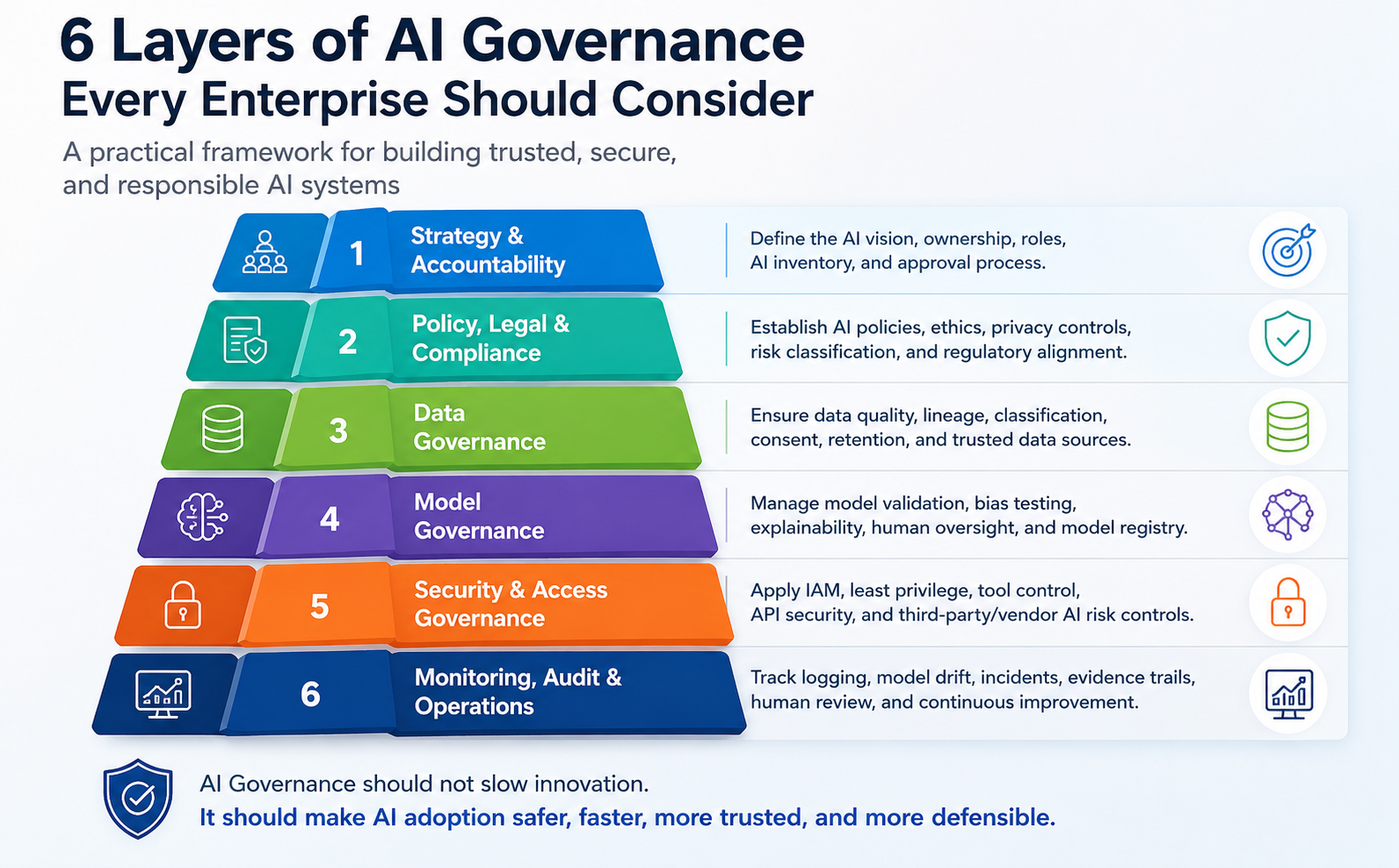
Six Layers of AI Governance Every Enterprise Should Consider
Artificial Intelligence is transforming how organizations operate, innovate, and make decisions. From AI copilots and Retrieval-Augmented Generation (RAG) platforms to autonomous agents and intelligent automation, AI is becoming deeply integrated into enterprise operations.
However, successful AI adoption requires more than powerful models and advanced technology. Organizations must establish a robust governance framework that ensures AI systems are trustworthy, secure, transparent, and aligned with business objectives.
The question is no longer:
“Can we use AI?”
The real question is:
“Can we trust it, secure it, explain it, monitor it, and defend it?”
A comprehensive AI Governance framework should address the following six critical layers.
1. Strategy & Accountability
Every successful AI initiative begins with a clear strategy and defined ownership. Organizations should establish an AI vision that aligns with business goals, define roles and responsibilities, maintain an inventory of AI systems, and implement structured approval and oversight processes.
Key Focus Areas:
- AI strategy and roadmap
- Ownership and accountability
- AI inventory management
- Governance committees
- Approval workflows
2. Policy, Legal & Compliance
As AI adoption grows, organizations must ensure compliance with regulatory requirements, ethical standards, and privacy obligations. Clear policies help mitigate risks while promoting responsible AI usage across the enterprise.
Key Focus Areas:
- AI usage policies
- Ethical AI principles
- Privacy and data protection
- Risk classification frameworks
- Regulatory compliance
3. Data Governance
AI systems are only as reliable as the data they use. Strong data governance ensures data quality, integrity, security, and traceability throughout the AI lifecycle.
Key Focus Areas:
- Data quality management
- Data lineage and traceability
- Data classification
- Consent management
- Data retention policies
- Trusted data sources
4. Model Governance
Organizations must maintain visibility and control over AI models to ensure fairness, accuracy, explainability, and accountability. Model governance provides the structure needed to manage AI systems responsibly from development through deployment.
Key Focus Areas:
- Model validation and testing
- Bias detection and mitigation
- Explainability and transparency
- Human oversight mechanisms
- Model registry and lifecycle management
5. Security & Access Governance
As AI systems gain access to critical business data and processes, security becomes a fundamental governance requirement. Proper access controls help prevent misuse, unauthorized access, and emerging AI-related threats.
Key Focus Areas:
- Identity and Access Management (IAM)
- Least-privilege access controls
- API security
- Tool and platform governance
- Third-party and vendor risk management
6. Monitoring, Audit & Operations
AI governance does not end after deployment. Continuous monitoring ensures that AI systems remain effective, compliant, and aligned with organizational objectives over time.
Key Focus Areas:
- Activity logging and audit trails
- Model performance monitoring
- Drift detection
- Incident management
- Human review processes
- Continuous improvement initiatives
Building Trust Through Responsible AI
Effective AI Governance should not slow innovation—it should enable it. By establishing the right controls, organizations can accelerate AI adoption while reducing risks and increasing stakeholder confidence.
In enterprise AI, success is not measured solely by the power of the model. It is measured by how responsibly an organization manages the entire AI lifecycle—from strategy and data governance to security, monitoring, and accountability.
Trusted AI is built on the foundation of the right purpose, the right data, the right model, the right access controls, the right monitoring practices, and the right accountability framework.
Organizations that invest in comprehensive AI Governance today will be better positioned to scale AI initiatives securely, responsibly, and successfully in the future.