
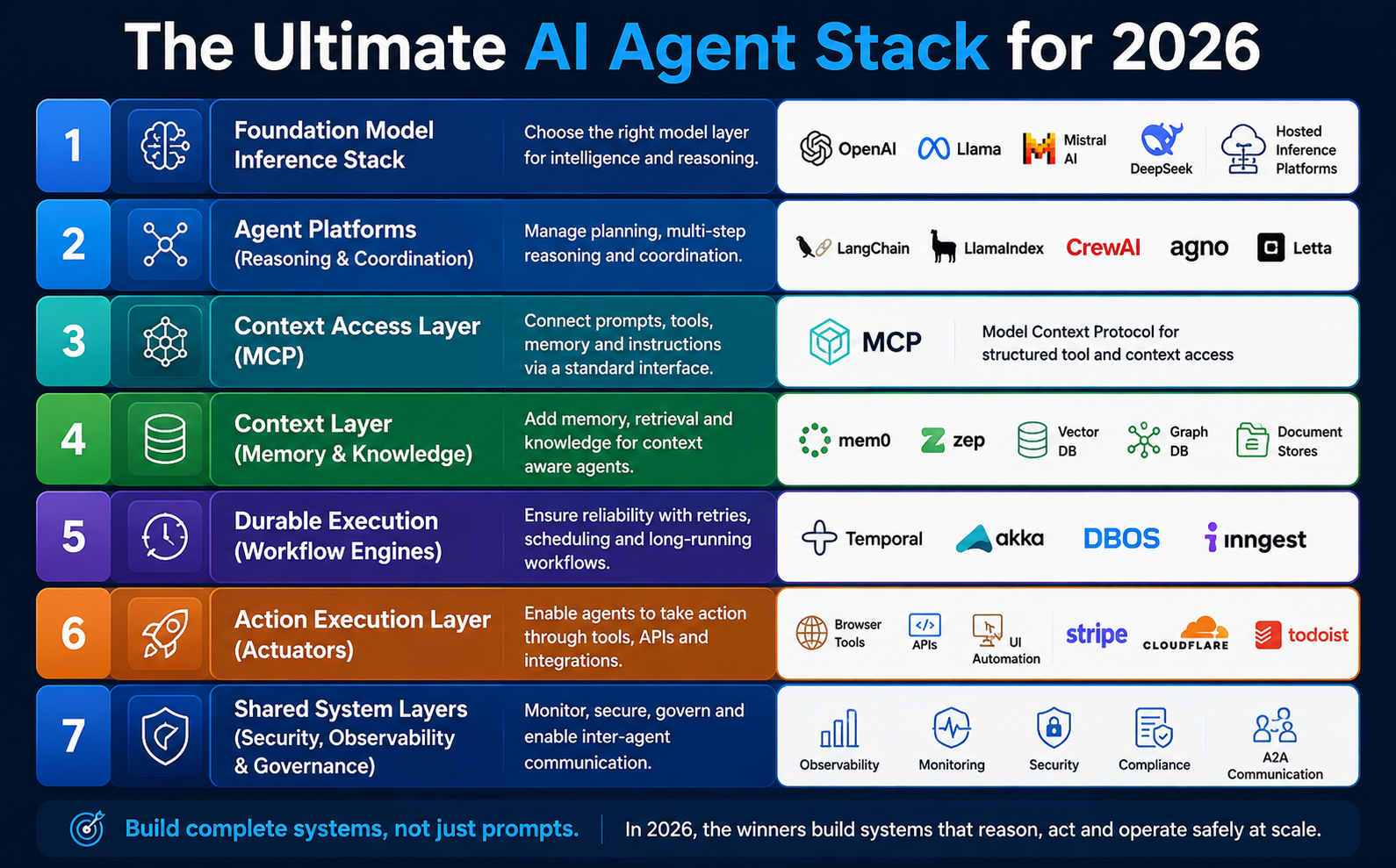
The Ultimate AI Agent Stack for 2026: Building AI Systems That Actually Scale
Artificial Intelligence is rapidly evolving from simple chatbots to intelligent agents capable of reasoning, planning, executing tasks, and interacting with complex business systems.
Many organizations start their AI journey by asking:
“Which model should we use?”
However, successful AI teams ask a different question:
“Which system are we building around the model?”
The reality is that modern AI agents are far more than prompts connected to an API. To operate effectively in enterprise environments, AI agents require memory, tools, workflows, security, monitoring, and reliable execution mechanisms.
The organizations that succeed in 2026 will not necessarily be those using the most advanced models. They will be the ones building complete, scalable, and trustworthy AI agent ecosystems.
The Complete AI Agent Technology Stack
1. Foundation Model Inference Layer
The foundation of every AI agent begins with selecting the right model infrastructure. Organizations can choose from leading providers and open-source models depending on performance, cost, privacy, and deployment requirements.
Examples:
- OpenAI
- Llama
- Mistral
- DeepSeek
- Hosted inference platforms
This layer provides the intelligence that powers reasoning, language understanding, and decision-making.
2. Agent Platforms (Reasoning & Coordination)
Agent frameworks help orchestrate multi-step reasoning, planning, and task coordination.
Popular frameworks include:
- LangChain
- LlamaIndex
- CrewAI
- Agno
- Letta
These platforms enable agents to break down complex tasks, coordinate workflows, and interact with external systems.
3. Context Access Layer
AI agents require structured access to tools, prompts, instructions, and memory.
The Model Context Protocol (MCP) is becoming a key standard for connecting AI models with external resources through a consistent interface.
Benefits include:
- Standardized tool access
- Structured context management
- Improved interoperability
- Better scalability
4. Context Layer (Memory & Knowledge Systems)
Without memory, agents cannot maintain continuity or learn from previous interactions.
A robust context layer provides:
- Persistent memory
- Knowledge retrieval
- Historical context
- Organizational knowledge access
Common solutions include:
- Mem0
- Zep
- Vector Databases
- Graph Databases
- Document Stores
This layer transforms AI agents from reactive assistants into context-aware systems.
5. Durable Execution Layer
Enterprise workflows often involve long-running tasks, retries, approvals, and scheduled actions.
Workflow engines provide reliability through:
- Task orchestration
- Failure recovery
- Scheduling
- State management
- Event-driven execution
Popular tools include:
- Temporal
- Akka
- DBOS
- Inngest
Without durable execution, agents struggle to operate reliably in production environments.
6. Action Execution Layer
The true value of an AI agent comes from its ability to take action.
This layer enables agents to:
- Interact with browsers
- Call APIs
- Automate user interfaces
- Execute business workflows
- Integrate with enterprise systems
Examples include integrations with:
- Stripe
- Cloudflare
- Todoist
- CRM Platforms
- ERP Systems
7. Shared System Services
Cross-cutting capabilities are essential for enterprise-grade AI deployments.
These include:
- Observability
- Monitoring
- Security
- Compliance
- Governance
- Audit Trails
- Agent-to-Agent (A2A) Communication
These services ensure that AI systems remain secure, trustworthy, and compliant at scale.
Why This Stack Matters
An AI agent becomes truly valuable when it can:
- Understand context
- Reason effectively
- Access knowledge
- Execute actions
- Operate reliably
- Scale securely
Focusing solely on model selection limits the potential of AI initiatives. Building a complete AI agent architecture creates systems that are resilient, maintainable, and capable of delivering real business value.
The Future of Enterprise AI
As organizations move toward autonomous workflows and intelligent operations, success will depend less on choosing the “best model” and more on designing the right ecosystem around that model.
The future belongs to organizations that treat AI agents as complete systems—not standalone models.
When evaluating your AI strategy, don’t ask:
“Which model should we use?”
Ask:
“Which AI agent system are we building?”
Because in 2026, the competitive advantage will come from architecture, reliability, governance, and execution—not just intelligence.