
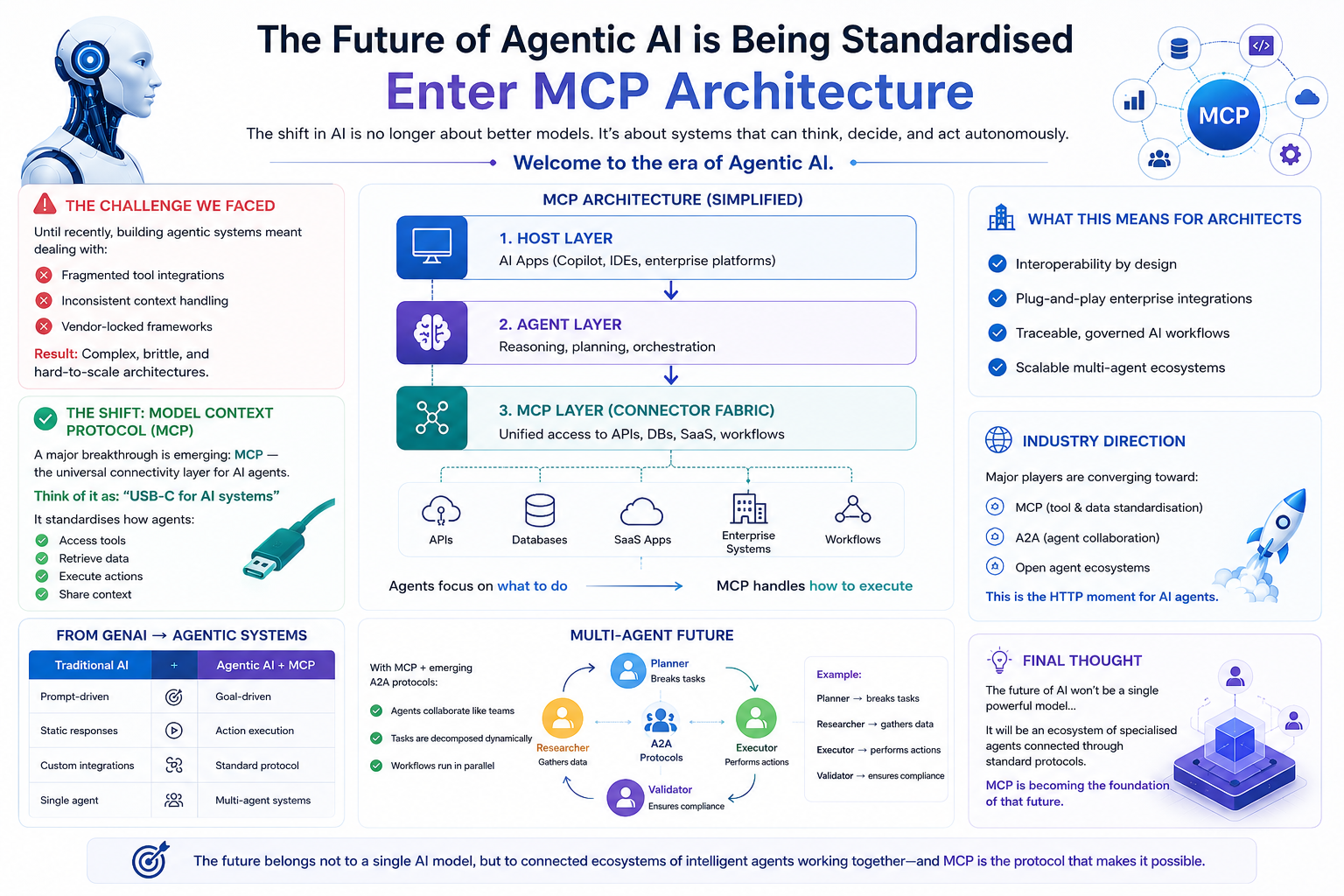
The Future of Agentic AI is Being Standardized: Enter MCP Architecture
Artificial Intelligence is entering a new era. For years, innovation focused on building larger and more capable language models. Today, the focus is shifting toward something even more transformative: Agentic AI—AI systems that can reason, plan, make decisions, and take actions autonomously.
However, building truly intelligent AI agents has been challenging due to fragmented integrations, inconsistent data access, and vendor-specific architectures. This is where Model Context Protocol (MCP) is emerging as a game-changing standard.
Understanding the Rise of Agentic AI
Traditional Generative AI systems primarily respond to prompts. They generate text, images, or code based on user instructions, but their capabilities are often limited to answering questions or producing content.
Agentic AI takes this a step further by enabling AI systems to:
- Understand goals rather than simple prompts
- Plan tasks independently
- Access tools and external systems
- Execute actions automatically
- Collaborate with other AI agents
Instead of simply providing information, Agentic AI actively works toward achieving objectives.
For example, an AI agent could receive a request to prepare a market analysis report. Rather than generating a generic response, it can gather data, analyze trends, create visualizations, validate findings, and deliver a complete report with minimal human intervention.
The Challenges of Building Agentic Systems
While the vision of autonomous AI agents is exciting, organizations have faced several architectural challenges:
Fragmented Tool Integrations
Every application, database, API, and SaaS platform requires custom integration, increasing development complexity.
Inconsistent Context Management
Different AI systems manage context differently, making it difficult to maintain continuity across workflows.
Vendor Lock-In
Organizations often become dependent on specific AI platforms or frameworks, reducing flexibility and increasing costs.
Scalability Limitations
As the number of agents and tools grows, maintaining and governing these systems becomes increasingly difficult.
These challenges have slowed the adoption of large-scale agent ecosystems.